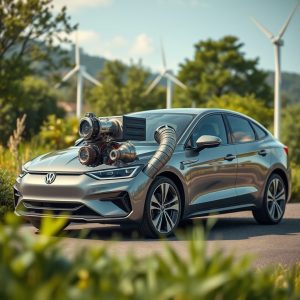
The Hidden Heroes of Carbon Neutral Mobility: How Exhaust Aftertreatment and Thermal Efficiency Are Shaping the Future

The push toward carbon neutral mobility has dominated automotive innovation, with electric vehicles (EVs) and hydrogen fuel cells often stealing the spotlight. Yet, beneath the surface of these high-profile technologies lies a quieter, equally critical revolution: the optimization of internal combustion engines (ICEs) and hybrid powertrains through exhaust aftertreatment and thermal efficiency. These advancements are not just bridging the gap to a zero-emission future—they are redefining what sustainable transportation can look like today.
The Unseen Challenge: Cleaning Up Combustion
Internal combustion engines have long been vilified for their environmental impact, but modern engineering has transformed them into far cleaner machines than their predecessors. The key lies in exhaust aftertreatment systems, which have evolved from simple catalytic converters to sophisticated networks of selective catalytic reduction (SCR), diesel particulate filters (DPF), and lean NOx traps (LNT). These systems work in tandem to neutralize harmful emissions like nitrogen oxides (NOx), carbon monoxide (CO), and particulate matter before they ever leave the tailpipe.
For example, SCR systems inject a urea-based solution (AdBlue) into the exhaust stream, converting NOx into harmless nitrogen and water vapor. Meanwhile, DPFs physically trap soot particles, which are then burned off during regeneration cycles. The result? Modern diesel engines can achieve near-zero emissions levels, rivaling some of their electric counterparts in urban environments where air quality is a pressing concern.
Thermal Efficiency: The Quest for More Miles per Gallon
While exhaust aftertreatment tackles emissions post-combustion, thermal efficiency focuses on maximizing the energy extracted from every drop of fuel. Turbocharged direct injection (TDI) and advanced combustion strategies like dual fuel combustion have pushed ICE efficiency to new heights. Today’s most advanced engines can convert over 40% of fuel energy into usable power, a marked improvement from the 20-30% efficiency of engines from just a few decades ago.
Hybrid powertrains take this a step further by pairing ICEs with electric motors and regenerative braking systems. The ICE operates in its most efficient range, while the electric motor handles low-speed driving and recovers energy during deceleration. This synergy not only reduces fuel consumption but also lowers emissions, making hybrids a compelling stopgap until battery-electric and hydrogen-powered vehicles achieve widespread adoption.
The Role of Synthetic and Biofuels in Decarbonization
Even as EVs gain traction, liquid fuels remain indispensable for long-haul transportation, aviation, and shipping. Here, synthetic fuels and eco-friendly biofuels offer a lifeline. Renewable diesel, derived from waste oils and agricultural residues, can drop into existing diesel engines with little to no modification, slashing lifecycle carbon emissions by up to 80%. Similarly, synthetic fuels—produced using renewable electricity and captured CO2—can achieve carbon neutrality when powered by wind or solar energy.
These fuels don’t just extend the relevance of ICEs; they also provide a pathway to decarbonize sectors where electrification is impractical. For instance, a trucking fleet running on renewable diesel can achieve immediate emissions reductions without waiting for new infrastructure or battery technology to mature.
Connected Car Technology: The Brain Behind the Brawn
Optimizing thermal efficiency and exhaust aftertreatment isn’t just about hardware—it’s also about software. Connected car technology and advanced battery management systems (BMS) enable real-time monitoring and adjustment of engine parameters. Predictive algorithms can anticipate driving conditions, adjusting fuel injection, turbocharger boost, and exhaust treatment on the fly to minimize waste and emissions.
For hybrids, BMS plays a dual role: managing the battery pack’s health while ensuring seamless power delivery between the ICE and electric motor. This intelligence is what allows a hybrid to achieve 50+ miles per gallon in real-world driving, far surpassing the efficiency of conventional ICEs.
The Road Ahead: A Multi-Pronged Approach to Sustainability
The future of sustainable transportation isn’t a single technology—it’s a mosaic of solutions tailored to different needs. Solid-state batteries may one day make EVs the undisputed kings of efficiency, but until then, advancements in exhaust aftertreatment, thermal efficiency, and alternative fuels will play a crucial role in reducing emissions. Even as autonomous driving systems and smart charging infrastructure capture headlines, the quiet evolution of ICEs and hybrids ensures that progress isn’t delayed by the limitations of any one technology.
What’s clear is that carbon neutral mobility isn’t a distant dream—it’s being built today, one innovation at a time. Whether through the silent hum of a hybrid’s electric motor or the unseen chemistry of a catalytic converter, the journey toward a cleaner future is already underway, driven by the hidden heroes of automotive engineering.